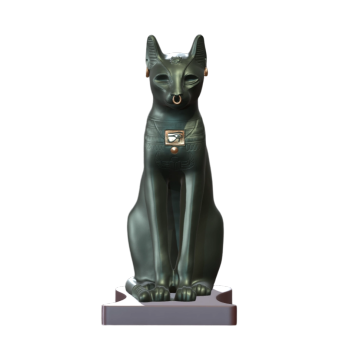
Gail-Anderson Cat

Gail-Anderson Cat

Gail-Anderson Cat is a bronze statue depicting the image of the goddess Buster. The goddess is usually portrayed as a female figure of the head of the cat, or directly in the form of a cat. The main center of worship of the goddess Bast is located in Bubatis, in the Nile Delta. As a maternal goddess, Buster is gentle and kind, in contrast to the more aggressive lioness god, Sehmet. The statue dates back to the late dynasty of ancient Egypt, around 600 BC. Major Robert Grenville Gail-Anderson donated the statue to the British Museum in 1939 and named it in his honor.
Hindu Heritage Ganesh Statue

Hindu Heritage Ganesh Statue

This statue of Ganesh is an important symbol in Hindu culture, and Ganesh is famous for its elephant head and kind face. He is regarded as the "master of the beginning of all things", both the maker of obstacles and the remover of obstacles. This statue is carved from stone. Ganesh sits in an elegant "lazy sitting position" (Lalitāsana) with the goddess Lakshmi (Lakṣmī) on his lap, symbolizing the transcendence of spiritual power.
Horse Head Marble Carving

Horse Head Marble Carving

A sculpture of a tomb monument or shrine discovered in Taranto, Italy, now located at the British Museum in London, was made around 350-300 BC.
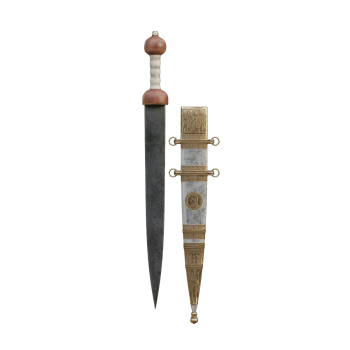
The Sword of Tiberius in Ancient Rome

The Sword of Tiberius in Ancient Rome

It is a famous ancient Roman sword and its scabbard, discovered near the Rhine River in Mainz, Germany. Since 1866, it has been a collection of the British Museum, donated to the museum by philanthropist Felix Slade. This sword is made of iron, and its scabbard is made of bronze plated with tin and gold. The decoration on the scabbard depicts the scene of Tiberius ceding military victory to Augustus after a successful Alpine campaign. Augustus, half naked, sat in Jupiter's seat, flanked by the Roman goddess of victory and the god of Mars Urtor, while Tiberius, dressed in military uniform, presented a small statue of the goddess of victory to Augustus.
Lancaster Cross Stele

Lancaster Cross Stele

The Lancaster Cross is an ancient stone cross stele, with one of its arms missing. The cross tablet is inscribed with the following rune: 'Pray for Cyniballth and Cuthbert'. The height of this cross shaped monument is 920 millimeters, the width is 400 millimeters, and the depth is 145 millimeters. Discovered near Lancaster, it was taken to St. Wilfried's Church in Halton to protect it. This cross shaped stele can be traced back to the 10th century and is an Anglo Norse cross shaped stele column, with the top part missing. It is currently housed in the British Museum.
Portrait statue of a Cypriot man

Portrait statue of a Cypriot man

This statue is a portrait of a man from Cyprus, made around 350 to 250 BC. This statue was discovered in the Apollo Temple and has a height of 50.50 centimeters. It is now on display in the British Museum.
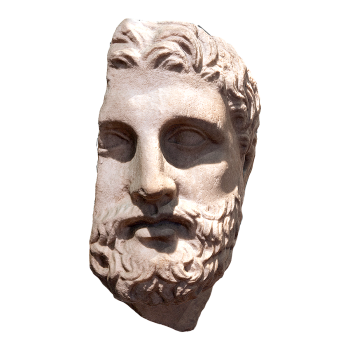
Marble statue of the head of a man with long beard
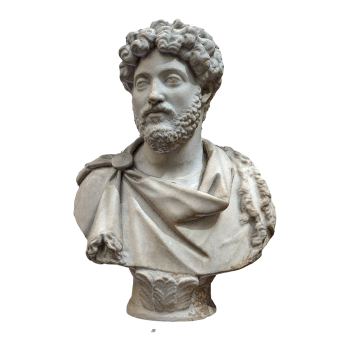
Marble statue of the head of a man with long beard

This marble statue is the head of a bearded man, possibly representing the ancestors of King Mausollos. This work was discovered around 350 BC in the main sculptural sediment north of the North Peripolis Wall, carved from marble. This statue is now on display at the British Museum.
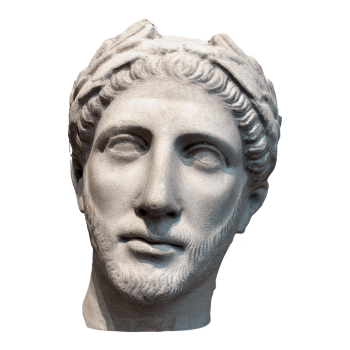
Marble bust of Roman Emperor Marcus Aurelius

Marble bust of Roman Emperor Marcus Aurelius

This marble statue is the bust of Roman Emperor Marcus Aurelius, wearing a tassel cloak. The height of this statue is 73.66 centimeters and it comes from Jason Magnus' house. The production date of this statue is approximately between 160 and 170 AD. This statue is now on display at the British Museum.
Lucius relief bust

Lucius relief bust

This Roman stone tomb relief depicts Lucius Antius Philomorsus, his daughter, and his wife. The relief is depicted in the style of the Roman Republic. The production date of this work is from 15 BC to 5 AD, and the dimensions are: height of 61 centimeters, width of 165 centimeters, and depth of 18.5 centimeters. This relief is currently housed in the British Museum.
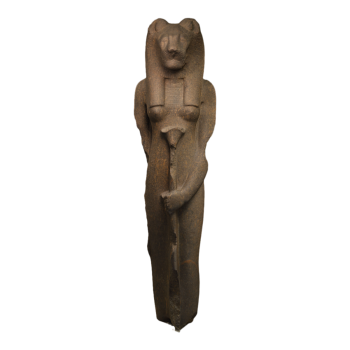
The Sykes Standing Statue, a diorite statue from the 18th Dynasty of ancient Egypt

The Sykes Standing Statue, a diorite statue from the 18th Dynasty of ancient Egypt

This cultural relic is a granite diorite statue of the 18th Dynasty standing in the position of Saikemaite. This is a statue depicting the goddess Sykes, who appears in the form of a lion headed female body but wears a sacred female wig. Her left foot is forward, her left hand holds a papyrus staff, and her right hand holds the Ankh of Life. Most of the right arm of this statue has been lost. The height of this statue is 120 centimeters, the width is 49 centimeters, and the depth is 47 centimeters. It is currently housed in the British Museum.
Xinghou Gui during the reign of King Kang of the Western Zhou Dynasty

Xinghou Gui during the reign of King Kang of the Western Zhou Dynasty

Xinghou Gui, also known as Zhou Gongyi, is a national treasure level cultural relic and a first-class national cultural relic. It was unearthed in Xingtai City, Hebei Province in 1921 and is now housed in the British Museum in the UK. This box is a utensil with four animal hanging ears, a luxurious mouth and bulging belly, decorated with elephant patterns on the belly and feet, and has early Western Zhou characteristics. There is an inscription with 68 characters that reads: "In the third month of the month, Wang Lingrong, an imperial censor, was appointed as the Marquis of Jing. He was promoted to the rank of third grade official and was a native of the state, a high-ranking official, and a mediocre official. He was appointed as the Chief Inspector, and the Emperor of Lu was on the verge of prosperity. He was forced to travel up and down, but the Emperor did not have a winter order to investigate on the right side of the Zhou Dynasty. However, he dared not do so. Shao Zhenfu League, I am a vassal of the Emperor, and I have issued a.
Bronze ware from the Six Dynasties period, 'Six Dynasties Bronze Chicken shaped Incense Burner'

Bronze ware from the Six Dynasties period, 'Six Dynasties Bronze Chicken shaped Incense Burner'

This cultural relic is a bronze vessel called "Censer, bird shaped", which was created during the Six Dynasties period in China (220-589 AD). This incense burner is currently housed in the British Museum. The shape of this incense burner is a rooster with a chick. It is made of bronze and the size of this incense burner is 6 inches in height.
Qing Dynasty handmade sculpture of peacock stone horse

Qing Dynasty handmade sculpture of peacock stone horse

This cultural relic is a Chinese horse carved from peacock stone, dating back to the 19th century, and is currently housed in the British Museum.
The head of the sarcophagus of Vice King Merimose, a cultural relic from the 18th Dynasty of Egypt, is a limestone coffin

The head of the sarcophagus of Vice King Merimose, a cultural relic from the 18th Dynasty of Egypt, is a limestone coffin

Cultural relics from the 18th Dynasty of the New Kingdom of Egypt, consisting of fragments of the head of the sarcophagus of Vice King Merimose, were made during the reign of Amenhotep III from 1390 BC to 1352 BC and are currently housed in the British Museum.
Granite altar of the 26th Dynasty of Egypt "Ancient Egyptian hieroglyphic altar"

Granite altar of the 26th Dynasty of Egypt "Ancient Egyptian hieroglyphic altar"

The Egyptian statue of Horus from the Roman period, known as the "Horus Sitting Statue"

The Egyptian statue of Horus from the Roman period, known as the "Horus Sitting Statue"

This artifact, named the "Horus Sitting Statue," is a limestone sculpture depicting Horus dressed in Roman military uniform. It was made around the 1st to 2nd century AD and is currently housed in the British Museum. The arm of the sculpture has been lost, and there was originally a crown on top of the head, which may have been made of other materials. The details of the feathers on the falcon's head are finely crafted, and the eyes are humanoid with the pupils depicted. The feathers of the falcon god also serve as scales for the carapace, with its sleeves ending below the shoulders.
Porcelain from the Han Dynasty and Eastern Han Dynasty: "Han Dynasty Ceramic Fish Pond"

Porcelain from the Han Dynasty and Eastern Han Dynasty: "Han Dynasty Ceramic Fish Pond"

This cultural relic called "Han Dynasty Fish Pond Porcelain" is a ceramic product belonging to the cultural heritage of the Han Dynasty in China. It was made around the period from the 1st century BC to the 2nd century AD. The diameter of this cultural relic is 39.40 centimeters and the height is 35.50 centimeters. This artifact is collected by the British Museum.
The marble statue of the ancient Greek classical period, known as the 'Giant Right Foot Statue'

The marble statue of the ancient Greek classical period, known as the 'Giant Right Foot Statue'

A huge right footed statue, once part of a statue several times its actual size. This statue is made of Parian marble. In ancient times, only the images of gods and emperors were made to such a scale. This statue is wearing a complex Greek style sandal, which first appeared in the 4th century BC. This statue is currently housed in the British Museum in London.
The marble statue of Alexander the Great from the ancient Greek Empire period

The marble statue of Alexander the Great from the ancient Greek Empire period

The statue was made between the 2nd and 1st centuries BC and came from Alexandria, Egypt. The head of the statue has been cut to accommodate a separately made body. The back of the statue has been processed to receive the remaining parts of hair made from other materials. Alexander the Great was the king of the ancient Greek kingdom of Macedonia, located in present-day northern Greece and neighboring countries. Under his leadership, from 336 BC to 323 BC, Alexander the Great conquered Greek city states, the Persian Empire, and established over 70 cities, creating an empire spanning three continents and covering approximately two million square miles.
Pink granite statue of Ankhkirednefer in ancient Egypt

Pink granite statue of Ankhkirednefer in ancient Egypt

This statue has a beetle on its head, the symbol of Osorkon II engraved on its arm, and the image of Osiris inside the shrine. The edge of the shrine and the back pillar of the spire are both engraved with hieroglyphs. This statue was discovered in Ter Mashuta, Egypt, and is 62 centimeters high, 28 centimeters wide, and 38 centimeters long. It is now housed in the British Museum. Ankhkirednefer served as the Grand Inspector of the Palace and an excellent secretary of the Temple of Artum under the rule of Osorkon II, the fifth king of the 22nd Dynasty of Egypt.
Male statue from Cyprus

Male statue from Cyprus

This statue is the upper half of a huge limestone statue depicting a bearded man, possibly an worshipper or priest. The statue depicts a standing figure wearing a pleated robe, with a cloak draped over his left shoulder and a serrated fold at the edge. This statue can be traced back to 450 BC to 425 BC, with a height of 1.04 meters. The complete statue is at least 2 meters high. The statue comes from Cyprus, possibly from the Temple of Apollo, and is now located in the British Museum.
The sandstone statue of the Aztec civilization, "Sitting Mithrant Kutli"

The sandstone statue of the Aztec civilization, "Sitting Mithrant Kutli"

The statue of Mithrant Kutli, the Aztec god of death, is currently housed in the British Museum in London. This statue is carved from sandstone, which has not been found in the highlands of Mexico and may have been collected and transported from the coastal areas of the Gulf in northern Mexico. The back of this statue is engraved with three pictographic characters: 'Two skulls',' Five vultures', and 'Four houses'. Mithrant Kutli is the god of death in Aztec mythology, often depicted as a figure with a skull face.
Athena's Shield in the Parthenon during the Roman Empire

Athena's Shield in the Parthenon during the Roman Empire

This is a small marble statue from the Roman period, which is the Athena shield in the Parthenon temple. This artwork is currently housed in the British Museum in London. The statue was made between 100-150 AD. This shield showcases Athena's shield, which was originally part of the Parthenon temple.
Inscribed clay tablets from the Third Dynasty of Ur

Inscribed clay tablets from the Third Dynasty of Ur

The length of this mud board is 14.10 centimeters and the width is 2.80 centimeters. There are four columns of inscriptions on this clay tablet, which come from the Third Dynasty of Ur. The Third Dynasty of Ur, also known as the Neo Ur Empire, was established by the Sumerian city-state of Ur and ruled over the entire Mesopotamia from 2112-2004 BC. The two corners and left side of the mud board have been broken. This mudboard may have been found in the Umma area of Ur city. The inscription on this clay tablet may be related to the Shulgi of the Drehem calendar.
1 2 3 4 5 Next